
The Bureau of Internal Revenue’s (BIR) move toward Electronic Invoicing (E-Invoicing) and the Electronic Sales Reporting System is one of the more significant regulatory shifts to affect hotels and restaurants in recent years—not because it introduces entirely new operational concepts, but because it formalizes how official invoices are generated and how sales data are electronically reported to the BIR.
For many hotel and restaurant owners, the immediate challenge is not understanding the regulation in theory, but determining whether it applies to their business, when it will apply, and what practical changes—if any—are actually required. The lack of clear, operator-level explanations often leads to unnecessary anxiety, rushed system decisions, or the assumption that compliance is purely an IT problem.
This article is written from a hotel and restaurant operator’s perspective. It focuses on how E-Invoicing and Sales Reporting affect real-world operations: front desks, POS outlets, accounting workflows, online bookings, statutory discounts, voids, refunds, and system integrations. Rather than quoting regulations verbatim, it addresses the questions owners, general managers, and finance heads are already asking.
The goal is simple: to help you assess relevance, readiness, and next steps—without hype or alarm.
The FAQs below are intended to provide practical clarity so you can prepare deliberately, based on how your business actually operates.
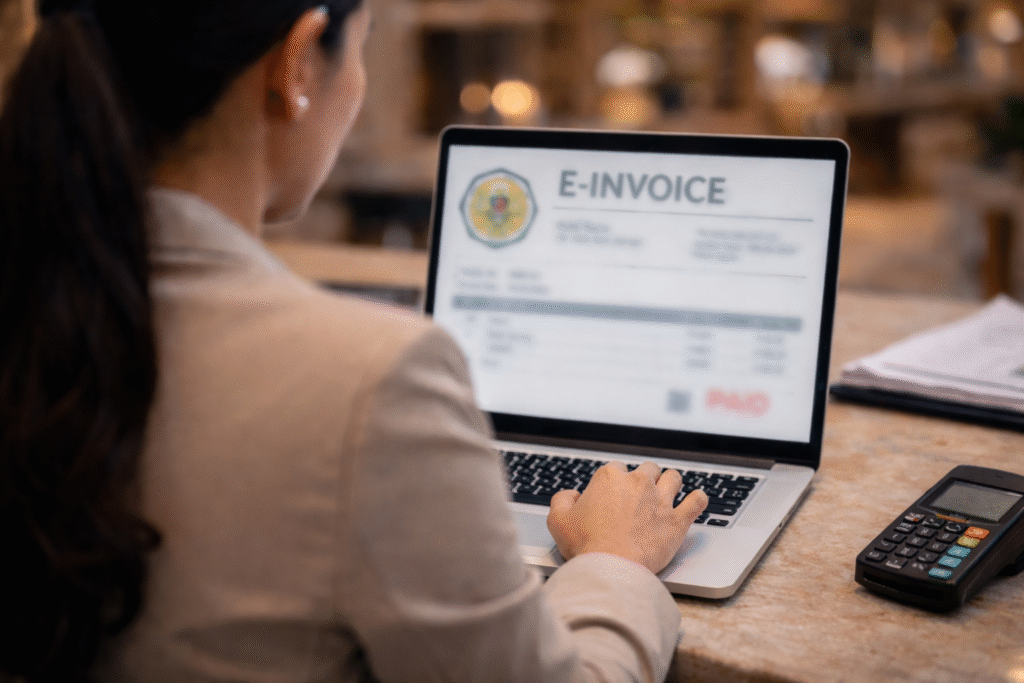
What Exactly Are E-Invoice, E-Invoicing, and the BIR Sales Reporting System?
Electronic Invoicing (E-Invoicing) is the process of electronically generating and issuing official invoices in a structured digital format. These invoices (E-Invoices) may be electronically transmitted to the BIR and provided to guest or clients digitally (e.g., via email), depending on regulatory requirements.
The BIR Sales Reporting System is related but distinct. It refers to the electronic transmission of sales and invoice data—typically generated by POS systems or Computerized Accounting Systems (CAS)—from the taxpayer’s system directly to the BIR in a structured format.
In short, E-Invoicing governs how official invoices are electronically generated and issued, while the Sales Reporting System governs how sales and invoice data are electronically transmitted to the BIR.
Does This Apply to All Hotels and Restaurants?
Not all at once—but many hotels and restaurants will eventually fall within scope.
Applicability is determined by:
• Taxpayer classification (such as designation as a Large Taxpayer or other classifications identified by the BIR)
• Use of computerized systems, such as POS or CAS
• Specific designation by the BIR under implementing rules and future issuances
Hotels and restaurants classified as Large Taxpayers are required to comply within the prescribed transition period, currently extended to December 31, 2026.
Separately, businesses using POS systems or computerized accounting systems may also be required to submit sales data electronically once the BIR’s Sales Reporting System becomes mandatory for their classification.
What owners should do next:
Confirm your taxpayer classification and identify all systems used to generate invoices and sales data across your operations.
Who Is Required to Use E-Invoicing From the Outset?
The initial implementation focuses on taxpayers that already operate in organized, computerized transaction environments. This generally includes:
• Taxpayers engaged in e-commerce or internet transactions (Lazada, Shopee, Amazon Bazaar, etc.), including online booking and payment platforms (Agoda, Expedia, Trip, etc.)
• Taxpayers under the Large Taxpayers Service (LTS)
• Taxpayers designated as Large Taxpayers under the Ease of Paying Taxes Act and related issuances
• Businesses using Computerized Accounting Systems (CAS), computerized books, or invoicing systems, including integrated POS environments
Coverage is determined by taxpayer designation and system usage, in line with RR 11-2025 and subsequent issuances.
What owners should do next:
Confirm your taxpayer classification and document how invoices and sales data are generated, consolidated, and reported across all outlets and revenue centers.
Why Are Hotels and Restaurants More Exposed Than Other Businesses?
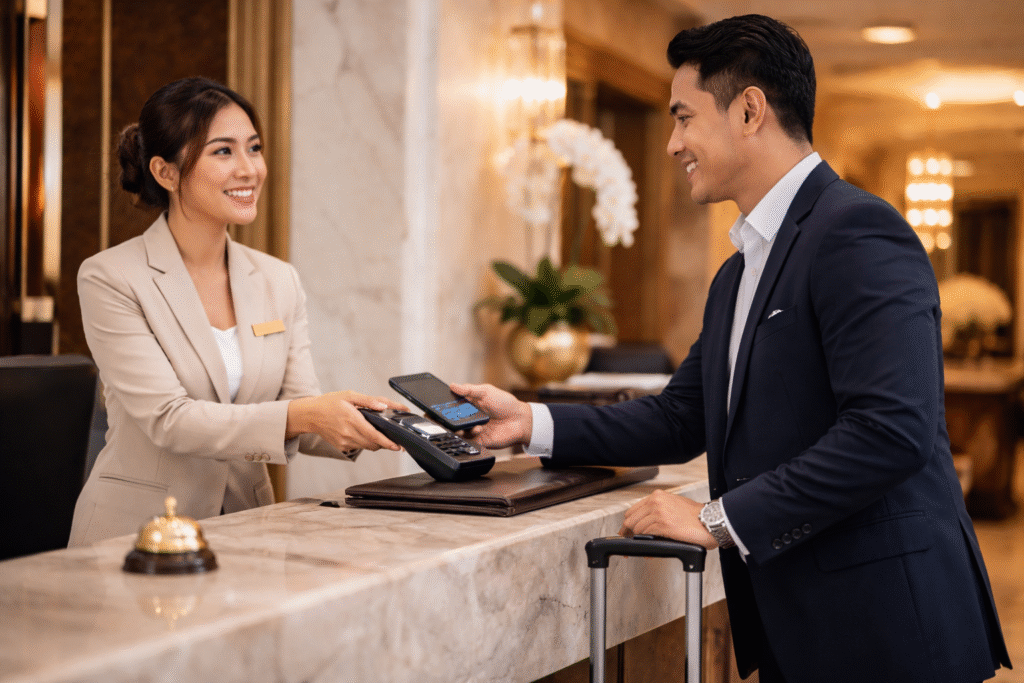
Hospitality operations involve complex and interrelated transactions, including:
• Multiple revenue centers and outlets
• Front desk and POS integrations
• Advance deposits, cancellations, and no-shows
• Split bills and multiple payment methods
• Statutory discounts (Senior Citizen, PWD, national athletes and coaches, solo parents)
• Online bookings and payments through OTAs and booking engines
These are routine scenarios. Risk typically arises during exceptions—such as voids, refunds, adjustments, and reversals—once transactions must be structured, standardized, and electronically reported.
What owners should do next:
Review SOPs for transaction handling and consistency. Review OTA and platform agreements to clearly establish who issues the sales invoice to the guest in each booking and payment scenario.
When Is the Deadline to Implement E-Invoicing and Sales Reporting?
Under Revenue Regulation No. 26-2025, taxpayers required to implement E-Invoicing are given until December 31, 2026 to comply.
The BIR Sales Reporting System is still under finalization, including its technical specifications, transmission protocols, and enforcement mechanics. Taxpayers should await further BIR issuances for final requirements and implementation schedules.
This ongoing finalization does not diminish the need for preparation. Hotels and restaurants are expected to align on how different outlets record transactions, apply statutory discounts, and handle exceptions in a consistent, standardized manner.
What owners should do next:
Monitor upcoming BIR issuances while proactively standardizing transaction treatment, discount rules, and outlet configurations.
Are There Incentives for Adopting E-Invoicing and Sales Reporting?
Yes. Current regulations provide tax incentives for adopting E-Invoicing and electronic sales reporting technologies.
Under existing rules:
- Micro and Small Taxpayers may deduct 100% of the total cost of implementing E-Invoicing and Sales Reporting technologies from taxable income.
- Medium and Large Taxpayers may deduct 50% of the total cost of implementing these technologies from taxable income.
Qualified costs may include system acquisition, implementation, integration, and related compliance expenses, subject to BIR conditions.
Beyond tax incentives, many hotels and restaurants also experience operational benefits such as improved audit trails, faster reconciliations, clearer control over statutory discounts and adjustments, and more consistent reporting across outlets.
What owners should do next:
Coordinate with your accountant and system provider to properly document qualifying expenses and evaluate E-Invoicing as both a compliance requirement and an operational improvement.
Does E-Invoicing Require Replacing Our Existing Systems?
Not necessarily. The determining factor is whether your POS or CAS can electronically transmit invoice and sales data to the BIR using an EIS-certified solution.
Hotel and restaurant owners should ask their system provider:
“Is your E-Invoicing transmission solution EIS-certified by the BIR, and can it be used to transmit our invoice and sales data to the BIR?”
Most businesses fall into one of three scenarios:
• Already EIS-certified and transmission-ready
• Not EIS-certified, but integratable with an EIS-certified provider
• Not technically capable of compliance and requiring a system upgrade or replacement
In all cases, the taxpayer must apply for a Permit to Transmit (PTT) authorizing the selected EIS-certified solution to connect to the BIR.
Final Thought
For hotels and restaurants, E-Invoicing and the BIR Sales Reporting System raise practical questions that go beyond compliance:
- Who issues the invoice when a guest books through an OTA?
- How are statutory discounts applied consistently across outlets?
- When exceptions occur, are they handled systematically or improvised?
Operators who prepare early will not only comply more smoothly—they will operate with greater clarity, control, and confidence.